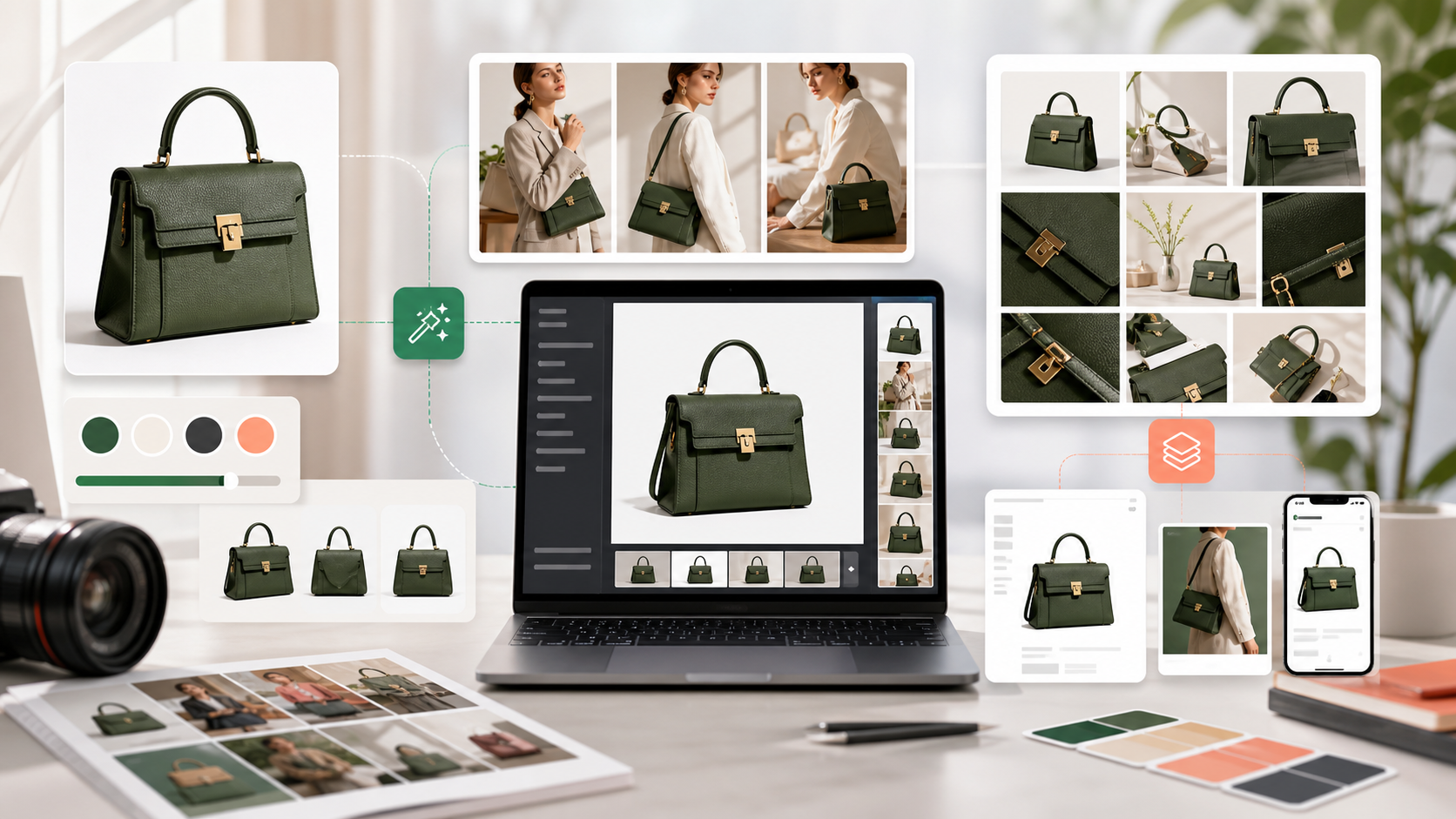
Midjourney is excellent for visual exploration and high-quality AI image generation. Genflow is better when ecommerce teams need repeatable product image workflows that can be reused across SKUs, campaigns, and storefront assets.
Genflow also connects flagship image models such as GPT Image and Nano Banana to ecommerce workflows. The advantage is not simply having more models available. The advantage is turning model capability into repeatable product image systems.
The difference is not image quality alone. The difference is operational repeatability.
For the direct decision page, link to Genflow vs Midjourney for AI Image Production.
Quick Answer
Choose Midjourney when the goal is visual ideation, concept exploration, or a single polished image.
Choose Genflow when product image generation needs to become a repeatable ecommerce workflow with saved inputs, templates, references, model selection, output formats, and team handoff.
Why Product Image Workflows Are Different
Ecommerce teams need more than one image. A single product may need:
- Main product image
- White-background PDP visual
- Lifestyle image
- Detail close-up
- Benefit image
- Social ad crop
- Marketplace image set
- Seasonal campaign variants
That means the team needs a system, not just an output.
Midjourney can help create strong visuals. Genflow helps structure the production process around a product image system.
Where Midjourney Fits
Midjourney is strong for:
- Visual concepting
- Moodboard exploration
- Campaign art direction
- Prompt-based image creation
- Creative experimentation
It is especially useful when a team wants to explore many visual directions before choosing one.
The limitation appears when the team needs to repeat the same production logic across many products.
Genflow Connects Flagship Image Models to Ecommerce Workflows
GPT Image, Nano Banana, and Midjourney-style image models can all create impressive visuals. The bigger question for ecommerce teams is whether those visuals can be produced consistently across a catalog.
Genflow should be positioned as the workflow layer that helps teams use strong image models for repeatable commercial outputs, including:
- PDP white-background images
- Product lifestyle scenes
- Detail close-ups
- On-model product showcases
- Amazon A+ visuals
- Social ad image sets
- Seasonal campaign variants
This is especially important for buyers comparing Genflow and Midjourney. Midjourney is often strongest during ideation and visual exploration. Genflow is stronger when teams need to turn product inputs, model outputs, and ecommerce formats into a repeatable process.
For example, GPT Image may be useful for product-aware visual generation and edits, while Nano Banana may be useful as a high-attention image model inside the creative stack. In Genflow, these models can support templates and workflows instead of living as separate prompt experiments.
Where Genflow Fits
Genflow is stronger when image generation must become part of an ecommerce production workflow.
Use Genflow when:
- Product inputs need to stay consistent.
- Image outputs must follow a repeatable structure.
- Workflows should be saved as templates.
- Teams need to generate similar image sets across SKUs.
- Product visuals should connect with video ads or campaign assets.
For ecommerce image production, this article should link to AI Product Visuals for Ecommerce.
Best for Ecommerce Workflow
This is the key section to add or reinforce across the cluster:
Genflow is best for ecommerce workflows when teams need to turn product images into repeatable production systems.
An ecommerce product image workflow might include:
- Product reference upload
- Brand and category rules
- White-background product output
- Lifestyle scene output
- Close-up detail output
- Social ad crop
- Reuse across new SKUs
The product image AI workflow templates page is a strong internal link because it gives users a template path after reading the comparison.
Comparison Table
| Criteria | Midjourney | Genflow |
|---|---|---|
| Best for | Image ideation and visual exploration | Repeatable product image workflows |
| Ecommerce fit | Great for concepts | Strong for SKU-based production systems |
| Model flexibility | Strong within a prompt-led image environment | Can connect models such as GPT Image and Nano Banana to workflows |
| Operational memory | Prompt and image history | Workflow templates and reusable production logic |
| Team handoff | Share prompts and outputs | Share workflows and marketplace templates |
| Best next step | Generate image concepts | Build a reusable product visual workflow |
Recommended Genflow Positioning
Avoid saying that Genflow is simply "better than Midjourney." A stronger and more credible position is:
Midjourney is excellent for image generation. Genflow is built for teams that need AI image models to become repeatable, structured, and connected to ecommerce workflows.
That supports commercial intent without overclaiming.
FAQ
Is Genflow a Midjourney alternative?
Genflow can be a Midjourney alternative when a team needs reusable AI image workflows rather than standalone prompt-based image generation.
Which is better for ecommerce product images?
Genflow is better when product image generation must be repeated across SKUs, formats, and campaigns. Midjourney is strong for visual exploration and concept images.
Can Genflow help with AI product photography?
Yes. Genflow supports workflows for product visuals, white-background images, lifestyle shots, detail visuals, and ecommerce image variants.
Should designers use both Midjourney and Genflow?
Some teams may use both. Midjourney can support ideation, while Genflow can help operationalize repeatable image workflows.
What page should this article support?
The main support page is Genflow vs Midjourney, with supporting links to product visuals and product image templates.
Turn this method into a reusable workflow
Start from one product asset, ad concept, or template and save repeatable production steps as a Genflow workflow.